

Aluminum 7010 - AL-P7010 - EN AW-7010 - EN AW-AlZn6MgCu - 3.4394
7010 is a structural 7xxx-series aluminum alloy designed for aerospace applications, maintaining strong performance in strength, fracture toughness, fatigue, and SCC in thick sections.Often described as the “European cousin” of 7050, its performance - like 7050’s - comes from overaged tempers (with T7651 and T73651 being the most common).From a manufacturing standpoint, it’s an alloy made for forging, generally poor for forming, good for machining, and with fusion welding (TIG/MIG) not recommended.
Available shapes :
Order 7010 Online
Select the desired form, standard, or specification and place your order with one click. A member of our sales team will contact you promptly to finalize your order.
Where did 7010 come from, and how is it positioned within the 7xxx family?
Initial need and performance requirements
7010 was developed from a straightforward aerospace need: reduce structural weight without compromising safety. That requires high strength so loads can be carried with less material. It also requires high toughness to better tolerate defects and damage. The alloy is also designed to offer good fatigue performance and strong resistance to stress-corrosion cracking, since highly loaded and exposed structures leave little room for poor compromises.
7010 is therefore positioned as a structural alloy. It is most often used as forged products, especially die forgings and large forged bars, for demanding aerospace components.
Aerospace positioning
In aerospace, European 7010 is broadly comparable to U.S.-origin 7050. These alloys are characterized by overaged tempers, T7651 for example, long associated with structural parts such as spars and ribs. These components make good use of the previously listed properties of 7010, as well as its ability to cover large thicknesses. With thicknesses reaching roughly 200 mm and 90 mm, it is suitable for major structural programs such as the A380.
What role do the alloying elements in 7010 play?
| Element | Role | Main effect (mechanism) |
|---|---|---|
| Zn | High performance | Basis of precipitation hardening through the formation of MgZn₂ (η) |
| Mg | High performance | Contributes to the formation of MgZn₂ (η); helps increase strength, especially yield strength |
| Cu | High-performance contribution | Influences and stabilizes the precipitation system; possible Cu segregation must be considered at the microstructural level |
| Zr | Strengthening in thick sections | Formation of dispersoids; recrystallization inhibition and better control of the structure |
| Cr+Mn | Negative, impurity | Incoherent dispersoids; influence on nucleation and microstructural stability |
| Ti | Contribution | Grain refinement (such as Al–Ti–B); finer grain structure and more uniform properties |
| Fe+Si | Negative, impurity | Formation of coarse phases; potentially detrimental effect on toughness |
Which metallurgical tempers shape 7010 performance?
What are overaged tempers (overaged conditions, T74/T76)?
7010 is typically used in tempers where a balance is struck between mechanical performance and environmental resistance. Overaged tempers such as T74 and T76 follow exactly this logic: accept some loss of strength compared with a peak-aged condition in order to improve resistance to stress-corrosion cracking. In other words, overaging is a trade-off lever when the priority is not simply to maximize tensile strength, but to preserve reliable in-service margins in highly loaded and exposed parts.
Examples of treatment cycles
For forgings in T74, one example of the processing route is expressed as a two-step aging cycle: 8 h at 110 °C, then 10 to 16 h at 175 °C.
A detailed cycle associated with T7651 is presented in the same document and illustrates a more complete approach. It includes solution heat treatment at 475 °C for 50 min, followed by water quenching at around 22 °C, with a reported cooling rate of about 95 °C/s. The process then mentions storage at −18 °C for more than 120 h, followed by a two-step aging treatment: 120 °C for 10 h, then 173 °C for 8 h.
What mechanical properties does 7010 offer depending on temper and orientation?
Tensile properties (yield strength Rp0.2, ultimate tensile strength Rm, elongation A): direct comparison between T7651 and T73651
In thick products, tensile properties must also be read by orientation: L (longitudinal), LT (long transverse), and ST (short transverse). At 20 °C, tempers T7651 and T73651 show high Rp0.2 and Rm values, with the ST direction being more penalizing for elongation.
Tensile properties at 20 °C (t/4 plane)
| Property | T7651 - L | T7651 - LT | T7651 - ST | T73651 - L | T73651 - LT | T73651 - ST |
|---|---|---|---|---|---|---|
| Yield strength Rp0.2 (MPa) | 459 | 452 | 401 | 435 | 435 | 397 |
| Ultimate tensile strength Rm (MPa) | 518 | 517 | 467 | 500 | 511 | 454 |
| Elongation A (%) | 10.8 | 9.6 | 3.8 | 9.0 | 10.0 | 4.2 |
Test notes: L and LT measured at the t/4 plane; some values are presented as averages from surface / core / t/4 plane measurements.
Typical ranges in thick products (T74 / T7452)
For large forgings and thick sections, performance thresholds provide simple benchmarks for achievable tensile strength and toughness, with particular emphasis on the L-T direction for toughness.
| Temper | Thickness (mm) | Ultimate tensile strength Rm (MPa) | Yield strength Rp0.2 (MPa) | Elongation A(5d) (%) | Fracture toughness K1c (L-T) (MPa√m) |
|---|---|---|---|---|---|
| T7452 | 120 / 150 | >475 | >400 | >8 | >27 |
| T74 | 100 / 125 | >485 | >420 | >7 | >27 |
KIC (damage tolerance): comparison between T7651 and T73651 in the available directions
KIC measurement chart: T7651 & T73651 in LT, TL, ST, and SL
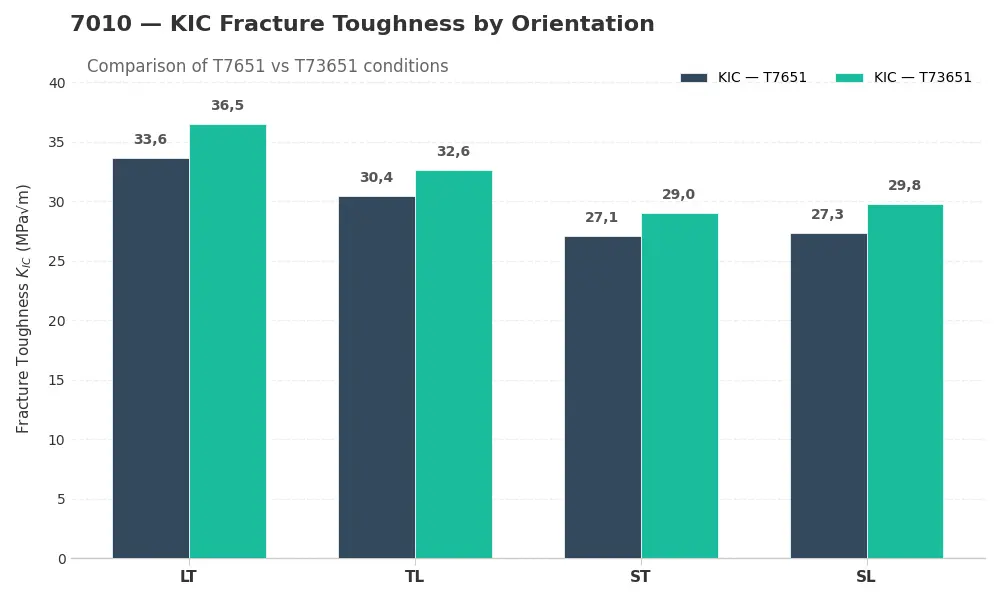
Average values calculated from two measurements per orientation in this paper.
Damage tolerance is assessed through fracture toughness KIC (MPa√m), depending on the LT, TL, ST, and SL orientation. On average, T73651 shows higher KIC values than T7651 in every direction. The difference remains moderate but consistent, ranging from +1.9 to +2.9 MPa√m depending on the orientation.
How does 7010 behave in fatigue and crack propagation as thickness increases?
Tests are carried out on T73651 and T651 conditions to understand how 7010 performs in fatigue as part thickness increases. N30–N8 corresponds to a typical “flight” loading cycle: higher load levels (N30) alternate with lower ones (N8) to reproduce what the part experiences in service (peaks plus calmer phases).
Flight simulation chart (N30–N8): thickness effect
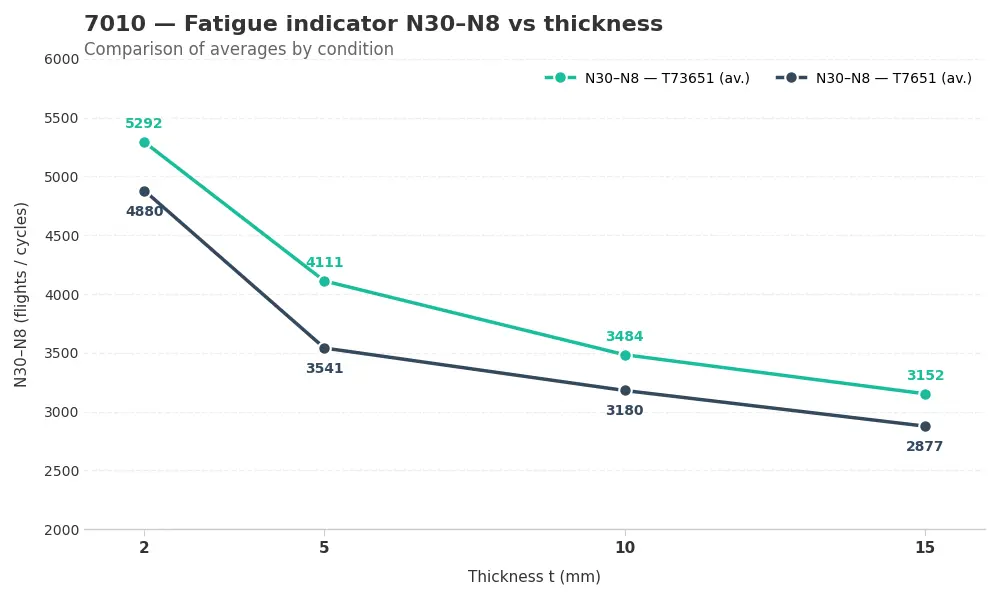
This chart shows that as thickness increases, fatigue life decreases for both heat-treatment conditions.
SCC resistance: T7651 & T3651
The SCC tensile test is conducted over 30 days under alternate immersion, with constant tensile strain. Results are reported both as stress (MPa) and as a percentage of yield strength Rp0.2, then counted as Macro and Macro+Micro observations, in F/N format.
Stress-corrosion cracking resistance chart for two overaged tempers: 30-day test (alternate immersion)
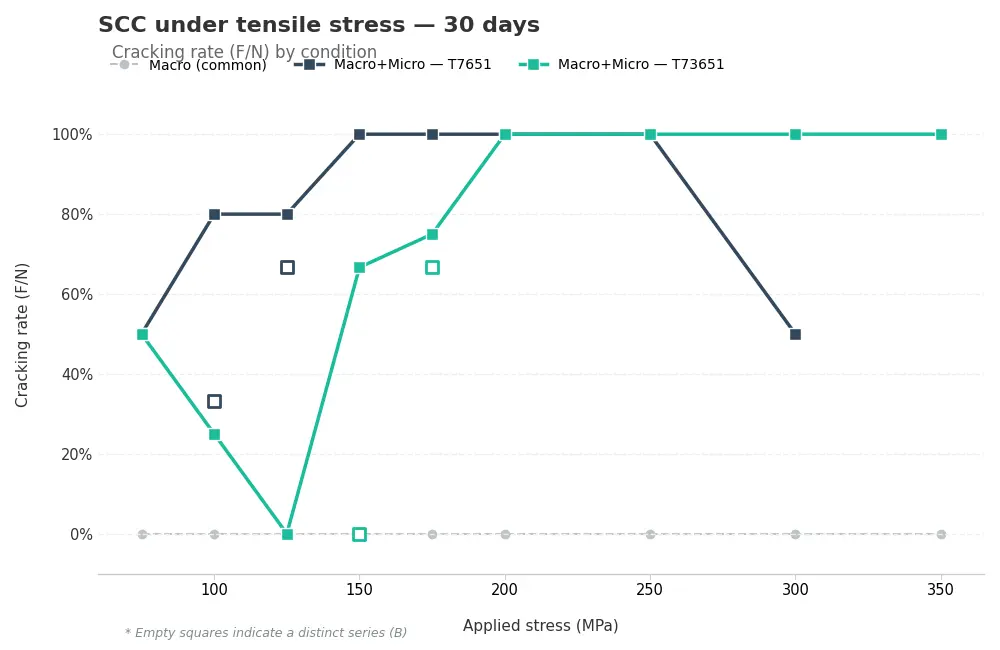
In the chart, each point corresponds to one row from Table 3 of this document:
- X = applied stress (MPa) (“Approx stress” in the report).
- Y = cracking rate = F/N (number of cracked specimens / number tested).
- Two readings are shown: Macro (surface cracks visible at low magnification) and Macro+Micro (also includes intergranular cracks observed microscopically, making it the more “sensitive” reading).
What are the implications for manufacturing and assembly (forming, machining, welding)?
7010 is considered an alloy primarily intended for structural and forged parts, not for severe forming operations such as deep drawing.
In forming, it is known to be very poor for deep drawing, poor for bending and impact extrusion, fair for extrusion molding, but favorable for forging (+).
On the machining side, it is generally good. For welding, fusion processes are clearly discouraged (TIG/MIG). Resistance welding is preferred and is comparatively more favorable.
Chemical composition of 7010
The mini/maxi variations in its chemical composition accepted for aerospace applications.
| % | Cr Chromium | Cu Copper | Fe Iron | Mg Magnesium | Mn Manganese | Ni Nickel | Si Silicon | Ti Titanium | Zn Zinc | Zr Zirconium |
|---|---|---|---|---|---|---|---|---|---|---|
| Min. | 0.00 | 1.50 | 0.00 | 2.10 | 0.00 | 0.00 | 0.00 | 0.00 | 5.70 | 0.10 |
| Max. | 0.05 | 2.00 | 0.15 | 2.60 | 0.10 | 0.05 | 0.12 | 0.06 | 6.70 | 0.16 |
Related aluminum alloys
2014, AlCu4SiMg, 3.1255, EN AW-2014
SHEET (THICKNESS < 6MM)
2014A
RECTANGULAR BAR, ROUND BAR, SHEET (THICKNESS < 6MM)
2017, AlCu4MgSi, AL4
SHEET (THICKNESS < 6MM), SHEET (THICKNESS> 6MM)
2024, AU4G1, 3.1354, EN AW-2024, Al-Cu4Mg1
SQUARE BAR, ROUND BAR, PROFILE, SHEET (THICKNESS < 6MM), SHEET (THICKNESS> 6MM), ROUND TUBE
2050
SHEET (THICKNESS > 6MM)
2219, AlCu6Mn, EN AW-2219
SHEET (THICKNESS > 6MM)
2524
SHEET (THICKNESS < 6MM)
2618, AU2GN, 3.1924, EN AW-AlCu2Mg1,5Ni, AL-P2618A
SHEET (THICKNESS > 6MM), ROUND TUBE
2618A
RECTANGULAR BAR, ROUND BAR, SHEET (THICKNESS > 6MM)
5005, EN AW-5005, EN AW-AlMg1(B)
PERFORATED SHEET
5052, EN AW-5052, EN AW-AlMg2,5, 3.3524, AL-P5052
ROUND TUBE
5086, EN AW-5086, EN AW-AlMg4, 3.3545, AB 5086
ROUND BAR, PROFILE, SHEET (THICKNESS < 6MM), PERFORATED SHEET, ROUND TUBE
5251, 3.3525, EN AW-5251, EN AW-AlMg2, EN AW-AlMgMn0,3
ROUND TUBE
5754, 3.3535, EN AW-5754, EN AW-AlMg3
PERFORATED SHEET
6061, 3.3214, EN AW-6061, EN AW-AlMg1SiCu
ROUND BAR, SHEET (THICKNESS < 6MM), SHEET (THICKNESS> 6MM), ROUND TUBE
6063, EN AW-6063, EN AW-AlMg0,7Si
SHEET (THICKNESS < 6MM)
6082, B221 6082, EN AW-AlSi1MgMn, EN AW-6082
ROUND BAR
7010-7050
SHEET (THICKNESS > 6MM)
7050, 3.4144, EN AW-P7050, EN AW-AlZn6CuMgZr
ROUND BAR, PROFILE, SHEET (THICKNESS > 6MM), ROUND TUBE
7055
SHEET (THICKNESS < 6MM), SHEET (THICKNESS> 6MM)
7075
RECTANGULAR BAR, ROUND BAR, PROFILE, SHEET (THICKNESS < 6MM), SHEET (THICKNESS> 6MM), ROUND TUBE
7075-7175
ROUND BAR
7150
RECTANGULAR BAR
7175
ROUND BAR, PROFILE, SHEET (THICKNESS > 6MM)
7449
SHEET (THICKNESS > 6MM)
7475, AL-P7475, EN AW-7475, EN AW-AlZn5,5MgCu(A), AL6
SHEET (THICKNESS < 6MM), SHEET (THICKNESS> 6MM)
CALE PELABLE
SHEET
L56
ROUND TUBE
Key properties
The most remarkable properties of this aluminum alloy.

Young's modulus
72 GPa

Tensile Strength
≥ 450 MPa

Yield Strength
≥ 360 MPa

Brinell Hardness
≥ 175 HB

