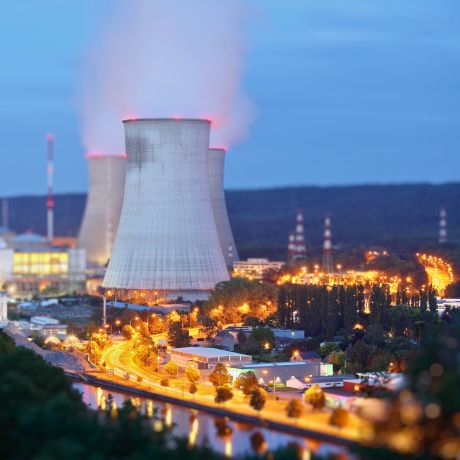

Stainless steel 347 AISI - X6CrNiNb18-10 - Z6CNNb18-11
AISI 347 is a work-hardenable austenitic stainless steel, notable for the addition of niobium to its composition. It is specifically designed for high-temperature environments where resistance to intergranular corrosion is critical, in applications where standard stainless steels such as 304 or 316 begin to fall short. Also designated S34700 (UNS) and 1.4550 (WNr), this alloy is widely used in aerospace, chemical processing and exhaust systems.
Available shapes :
Order AISI 347 Online
Select the desired form, standard, or specification and place your order with one click. A member of our sales team will contact you promptly to finalize your order.
The role of niobium and stabilization
The key feature of AISI 347 is its niobium stabilization (also called columbium in the United States). This addition addresses a major issue encountered with non-stabilized stainless steels (such as AISI 304): intergranular corrosion.
- The issue addressed: when conventional stainless steels are heated between 500 and 800 °C (for example during welding), carbon reacts with chromium to form chromium carbides at grain boundaries. This phenomenon locally depletes chromium, breaks down the protective layer, and opens the door to corrosion and cracking.
- The stabilization treatment: to be effective, the steel undergoes a stabilization anneal (typically around 885 °C). This treatment drives the reaction between carbon and niobium. Unlike non-stabilized grades, 347 can then be exposed for long periods to critical temperatures (427–816 °C) without risk of sensitization.
Corrosion resistance and service limitations
In general corrosion, alloy 347 offers performance comparable to 304, with excellent resistance in many oxidizing environments and atmospheric conditions. Its main advantage remains its resistance to intergranular corrosion after thermal exposure, significantly outperforming non-stabilized grades.
Limitations: 347 is not intended for reducing or marine environments. It performs poorly in chloride-containing solutions (even at low concentrations) and in sulfuric acid. Use in seawater should be avoided, as it is susceptible to pitting and crevice corrosion. For these environments, molybdenum-bearing grades such as 316L are preferred, as they are more resistant to localized attack.
Hot working (forging and rolling)
Hot working of AISI 347 (forging, rolling, drawing) requires strict temperature control, because the material combines good ductility with high resistance to deformation.
Typically, the recommended process is as follows:
- Heating: the steel should be heated uniformly to between 1 150 and 1 200 °C to make it workable.
- Deformation: it should be carried out progressively and stopped once the metal temperature drops below 950 °C, a threshold below which the material becomes too hard and may crack.
- Cooling: thanks to niobium stabilization, slow cooling through the critical range (500–800 °C) does not create a risk of subsequent corrosion, unlike 304. Cooling can therefore be done in air.
After hot working, a solution anneal (heating to 1 020–1 100 °C followed by rapid quenching in water or forced air) is recommended to restore a homogeneous austenitic structure.
High-temperature behavior and mechanical properties
AISI 347 is specifically selected for its high-temperature mechanical performance. It resists oxidation and scale formation up to about 800 °C. Above that, although oxidation becomes a limiting factor, it retains higher mechanical strength than common stainless steels.
For long-term service at temperatures close to 900 °C, the “H” version, 347H, is preferred. This grade specifies a higher carbon content (0.04–0.10 %) to maximize creep strength and stress-rupture resistance.
Change in mechanical properties
At room temperature (20 °C), in the annealed condition, the alloy typically shows an ultimate tensile strength (Rm) of 640 MPa and a 0.2% proof strength (Rp0.2) of 250 MPa. The table below shows how these values change with temperature:
| Temperature (°C) | Typical Rm (MPa) | Typical Rp0.2 (MPa) |
|---|---|---|
| 20 | 643 | 252 |
| 204 | 507 | 252 |
| 427 | 479 | 205 |
| 538 | 438 | 189 |
| 649 | 361 | 169 |
| 732 | 271 | 157 |
| 816 | 182 | 128 |
Note: a marked drop in mechanical properties is observed beyond 500 °C. At 816 °C, the tensile strength is only about one quarter of its initial value, which generally represents the upper limit for structural use.
Industrial applications
It is suitable for pressure vessels operating at high temperature, for example: boilers and heat exchangers.
Aerospace industry: components exposed to thermal cycling. It is used in gas turbine systems (recuperators, piping, combustor parts) due to its stability at high temperature and under pressure. It is also used in aircraft exhaust systems, including ring manifolds.
Petrochemical industry: high-temperature processing equipment in the oil and gas sector, such as cracking units, reactors, and distillation columns.
Power generation industry: steam piping, heat shields, and turbine system components (recuperators, piping, etc.).
Chemical composition of AISI 347
The variations in its chemical composition for aerospace.
| % | C Carbon | Cr Chromium | Mn Manganese | Nb Niobium | Ni Nickel | P Phosphorus | S Sulfur | Si Silicon |
|---|---|---|---|---|---|---|---|---|
| Min. | <0.00 | 17.00 | <0.00 | <0.00 | 9.00 | <0.00 | <0.00 | <0.00 |
| Max. | 0.08 | 20.00 | 2.00 | 1.10 | 13.00 | 0.045 | 0.030 | 1.00 |
Related stainless steel alloys
15-5PH, 1.4545, X5CrNiCu15-5, EZ5CNU15.15
RECTANGULAR BAR, ROUND BAR, PROFILE, SHEET
17-4PH, 1.4548, UNS S17400, AMS 5643, AMS 5622, S17400
SQUARE BAR, RECTANGULAR BAR, ROUND BAR, SHEET
17-7PH, S17700, 1.4568, AISI 631, X7CrNiAl17-7
SHEET
21-09-06, AMS 5561, Nitronic 40, S21900, X2CrMnNi21-6-9, Z4CMN 21-9-6
ROUND TUBE
AISI 301, Z12CN18-07, X12CrNi17-7, X10CrNi18-8
MOTHER COIL, COIL, SHEET
AISI 302, Z12CN18-09
SHEET
AISI 431, X17CrNi16-2, Z15CN16-02, FE PM42, 1.4057, APX
SQUARE BAR, RECTANGULAR BAR, ROUND BAR, SHEET
AISI 446
ROUND BAR
CALE PELABLE
SHEET
CUSTOM 465, MLX17, X1CrNiMoAlTi12-11
ROUND BAR
EZ100CD17
ROUND BAR
EZ12CNDV12
ROUND BAR
EZ15CN17-03
ROUND BAR
EZ1CNDAT12-09, MARVALX12, X1CrNiMoAlTi12-9
ROUND BAR
EZ2NKD18-8-5, MARAGING 250, X2NiCoMo18-8-5
RECTANGULAR BAR
EZ3NCT25, X3NiCrTi25
ROUND BAR, COIL, SHEET (THICKNESS > 6MM)
EZ6CND16-05-01
SQUARE BAR
EZ6NCT25, A286, X6NiCrTi25
SQUARE BAR, RECTANGULAR BAR, ROUND BAR, COIL, WIRE, SHEET
EZ8CND17-04
ROUND BAR
GD223, X50NiMnCr12, Z50NMC12
ROUND BAR
PH13-8Mo, X3CrNiMoAl13-08-02, Z3CND13-08
RECTANGULAR BAR, ROUND BAR
S130
ROUND BAR
S143
ROUND BAR
S143D
ROUND BAR
S144
ROUND BAR
S145
ROUND BAR
X12C13, X12Cr13, AISI 410, 1.4006, Z10C13
ROUND BAR, SHEET
X30Cr13, Z30C13
ROUND BAR
X6Cr17
ROUND BAR
X750
SHEET
Z100CD17
ROUND BAR
Z12CN13
SHEET
Z12CNDV12, JETHETE M152, X12CrNiMoV12
ROUND BAR, SHEET
Z25CNWS22
ROUND BAR
Z2CN18-10, AISI 304L, X1CrNi18-10
RECTANGULAR BAR, ROUND BAR, COIL, WIRE, PROFILE, SHEET, PERFORATED SHEET, PVC SHEET, ROUND TUBE
Z6CND16-05-01, APX4, Z8CND17-04, X4CrNiMo16-5-1
ROUND BAR, SHEET
Z6CNT18-10, AISI 321, X6CrNiTi18-10, X6CNT18-10
SQUARE BAR, RECTANGULAR BAR, ROUND BAR, COIL, SHEET, ROUND TUBE
Key properties
The most remarkable properties of this stainless steel alloy

Tensile Strength
485–1895 MPa

Impact Toughness
≥ 39.1 J

Yield Strength
≥ 205 MPa

Brinell Hardness
140–255 HB