

Aluminum 6063 - EN AW-6063 - EN AW-AlMg0,7Si
Wrought Al-Mg-Si alloy from the 6000 series, 6063 (EN AW-6063, UNS A96063) is a grade designed for extrusion, with a very good ability to achieve a high-quality surface finish and an excellent response to anodizing. It has therefore been particularly common since the 1950s in architectural profiles and shapes, where appearance and consistency matter as much as performance.
Available shapes :
Order 6063 Online
Select the desired form, standard, or specification and place your order with one click. A member of our sales team will contact you promptly to finalize your order.
What is 6063 aluminum alloy?
6063 is an aluminum alloy from the 6xxx series (Al-Mg-Si family), known for its very good extrudability and excellent surface finish. Depending on the designation system, it is referenced as EN AW-6063 (European standards), AA 6063 (Aluminum Association), and UNS A96063 (Unified Numbering System). Its common chemical designation is AlMg0.7Si, which reflects its magnesium-silicon base, typical of 6000 series alloys.
Main use case: extrusion and architectural applications
6063 is primarily selected for its extrusion performance: it is particularly well suited to producing complex, consistent extruded profiles with high productivity.
Its other major advantage, especially in architecture, is its surface quality: it easily achieves a clean and very smooth surface, making it ideal for facades, frames, and visible components. This is why it is widely used in architectural extruded profiles such as aluminum joinery, cladding, guardrails, and decorative shapes.
Finally, 6063 offers an excellent response to anodizing, especially in common extrusion tempers such as T5, T52, and T6, making it easier to achieve uniform shades and finishes across profile series.
Role of the alloying elements in 6063
There is also a European variant of 6063 called 6063A. The key difference between the two grades lies in a slightly richer chemistry on the 6063A side, especially for the minimum contents of Mg and Si, which results in a grade positioned more toward mechanical strength at an equivalent temper.
From a metallurgical standpoint, 6063 belongs to the Al-Mg-Si alloy family:
- The magnesium + silicon combination enables the formation of Mg₂Si, which is the basis of precipitation hardening and gives heat-treated tempers their value, as with other 6000 series alloys.
- Silicon (Si), by lowering the melting temperature and improving alloy fluidity, promotes both extrusion performance and surface quality.
- Copper (Cu) is kept at a low level in order to preserve corrosion resistance, at the cost of lower maximum strength potential than other more copper-rich 6000 series grades.
- Iron (Fe), the most common impurity in aluminum, promotes the presence of intermetallics that can contribute to localized corrosion (pitting) because of electrochemical contrasts with the matrix.
6063 tempers and mechanical properties
Definitions (EN 515 / ISO 2107 / ANSI H35.1)
T tempers describe treatment sequences applied to a wrought product in order to set its properties.
- T4 corresponds to solution heat treatment followed by natural aging (a stable temper that is generally more formable).
- T5 refers to a product cooled after hot forming, typically after extrusion, and then subjected to artificial aging.
- T6 corresponds to solution heat treatment followed by artificial aging, often chosen to maximize strength at an equivalent temper.
- Finally, suffixes such as _51 / _52 / _54 indicate stress-relieving variants (reduction of residual stresses) through processes defined by standards.
Extruded bars and tubes in 6063: EN 755-2 minimum values
The requirements below apply to extruded 6063 products according to EN 755-2, with minimum values defined by temper and dimension.
Extruded round bars
| Temper | Dimension | Rm (min) | Rp0.2 (min) | A (min) | A50 (min) | HBW (typ.) |
|---|---|---|---|---|---|---|
| O, H111 | D≤200, S≤200 | - | 130 (max) | - | - | - |
| T4 | D≤150, S≤150 | 130 | 65 | 14 | - | 50 |
| T4 | 150<D≤200, 150<S≤200 | 120 | 65 | 12 | - | 50 |
| T5 | D≤200, S≤200 | 175 | 130 | 8 | 6 | 65 |
| T6 | D≤150, S≤150 | 215 | 170 | 10 | 8 | 75 |
| T6 | 150<D≤200, 150<S≤200 | 195 | 160 | 10 | - | 75 |
| T66 | D≤200, S≤200 | 245 | 200 | 10 | 8 | 80 |
Extruded tubes
| Temper | Wall thickness t | Rm (min) | Rp0.2 (min) | A (min) | A50 (min) | HBW (typ.) |
|---|---|---|---|---|---|---|
| O, H111 | t≤25 | - | 130 (max) | 18 | - | 25 |
| T4 | t≤10 | 130 | 65 | 14 | 12 | 50 |
| T4 | 10<t≤25 | 120 | 65 | 12 | 10 | 50 |
| T5 | t≤25 | 175 | 130 | 8 | 6 | 65 |
| T6 | t≤25 | 215 | 170 | 10 | 8 | 75 |
| T66 | t≤25 | 245 | 200 | 10 | 8 | 80 |
These tables show that T6 and T66 tempers provide the highest strength levels, while T4 retains more margin in terms of formability (A).
Example comparison of 6063 and 6063A properties: extruded profiles
6063 extruded profiles: EN 755-2 minimum values (T5, T6)
| Temper | Wall thickness t | Tensile strength Rm (min) | Yield strength Rp0.2 (min) | Elongation at break A (min) | A50 (min) | Brinell hardness HBW (typ.) |
|---|---|---|---|---|---|---|
| T5 | t ≤ 3 mm | 175 MPa | 130 MPa | 8 % | 6 % | 65 |
| T5 | 3 < t ≤ 25 mm | 160 MPa | 110 MPa | 7 % | 5 % | 65 |
| T6 | t ≤ 10 mm | 215 MPa | 170 MPa | 8 % | 6 % | 75 |
| T6 | 10 < t ≤ 25 mm | 195 MPa | 160 MPa | 8 % | 6 % | 75 |
For extruded profiles in 6063 or 6063A, the EN 755-2:2008 standard defines minimum values by temper and thickness range. A simple pattern emerges: as thickness increases, the required minimum strength and ductility values tend to decrease.
6063A extruded profiles: EN 755-2 minimum values (T5, T6)
| Temper | Wall thickness t | Tensile strength Rm (min) | Yield strength Rp0.2 (min) | Elongation at break A (min) | A50 (min) | Brinell hardness HBW (typ.) |
|---|---|---|---|---|---|---|
| T5 | t ≤ 10 mm | 200 MPa | 160 MPa | 7 % | 5 % | 75 |
| T5 | 10 < t ≤ 25 mm | 190 MPa | 150 MPa | 6 % | 4 % | 75 |
| T6 | t ≤ 10 mm | 230 MPa | 190 MPa | 7 % | 5 % | 80 |
| T6 | 10 < t ≤ 25 mm | 220 MPa | 180 MPa | 5 % | 4 % | 80 |
6063 vs 6063A: which one to choose?
At comparable shape and thickness (EN 755-2 extruded profiles), 6063A is positioned as a more strength-oriented variant, while 6063 retains a more balanced profile in terms of ductility.
In T6, the strength advantage of 6063A remains clear, but the key point to watch becomes elongation at break A: for 10 < t ≤ 25 mm, 6063A drops to A = 5%, while 6063 remains at A = 8% in the same thickness range. In practical terms, if the priority is guaranteed minimum strength, 6063A is often better positioned; if the goal is more ductility margin (forming, tolerance to defects, in-service behavior), 6063 may be the more comfortable option at an equivalent temper.
High-temperature behavior of 6063-T5: performance loss with temperature
E / fy / fu table from ~24 °C to 600 °C
These data come from steady-temperature tensile tests on 6063-T5, with temperature held constant before loading to failure. The values are reported as elevated-temperature material properties (E, fy, fu). The calculation is based on the coefficients published in Su & Young’s article (Table 3), derived from the values in Table 2. The resulting data do not match the values shown in Table 2 of the article PDF, which appears to result from a reporting error in the publication.
| Temperature (°C) | ET/E coeff. | Calculated E (MPa) | fy/fy24 coeff. | Calculated fy (MPa) | fu/fu24 coeff. | Calculated fu (MPa) |
|---|---|---|---|---|---|---|
| 24 | 1.00 | 65 600 | 1.00 | 186.6 | 1.00 | 226.7 |
| 101.2 | 0.97 | 63 632 | 0.98 | 182.9 | 0.96 | 217.6 |
| 200.9 | 0.86 | 56 416 | 0.87 | 162.3 | 0.81 | 183.6 |
| 253.1 | 0.83 | 54 448 | 0.79 | 147.4 | 0.70 | 158.7 |
| 300.8 | 0.79 | 51 824 | 0.70 | 130.6 | 0.61 | 138.3 |
| 350.4 | 0.72 | 47 232 | 0.60 | 112.0 | 0.50 | 113.4 |
| 400.6 | 0.69 | 45 264 | 0.36 | 67.2 | 0.31 | 70.3 |
| 449.7 | 0.67 | 43 952 | 0.25 | 46.7 | 0.22 | 49.9 |
| 502.1 | 0.52 | 34 112 | 0.10 | 18.7 | 0.08 | 18.1 |
| 602.3 | 0.44 | 28 864 | 0.04 | 7.5 | 0.03 | 6.8 |
Implications
Figure 1: evolution of 6063-T5 mechanical properties with temperature (based on Su & Young, 2019)
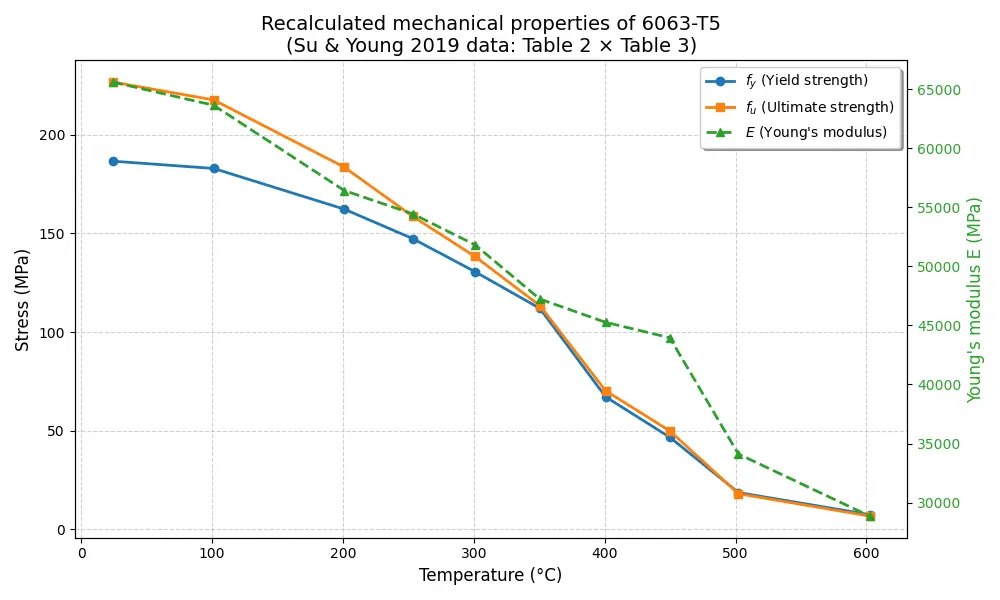
Analysis (Su & Young, 2019 data):
- Relative stability: performance remains relatively stable up to around 200 °C.
- Critical drop: strength drops sharply between 200 °C and 400 °C.
- Stiffness vs. strength: Young’s modulus (E) degrades much more slowly than yield strength (fy) at elevated temperature.
6063 corrosion resistance and anodizing
6063 offers excellent atmospheric corrosion resistance, making it a very reliable grade for outdoor use. Its limits mainly appear in severe environments, when moisture and chlorides remain trapped: the main risk then becomes localized corrosion (pitting and crevice corrosion), typically in stagnant water conditions.
This behavior is promoted by intermetallics rich in Fe-Si-Al (sometimes Fe-Si-(Mn)-Al), which can create micro-galvanic couples with the matrix (typical potential difference ~225–280 mV), leading to local dissolution and then pit formation.
Regarding stress corrosion cracking, 6063 is generally only slightly sensitive in normal service because it belongs to the Al-Mg-Si alloy family and remains far from heavily alloyed Al-Mg grades.
Finally, 6063 is a decorative standard thanks to its very smooth surface and excellent anodizing response, especially in common profile tempers such as T5, T52, and T6.
Processing 6063: extrusion, forming, machining, and welding
Extrusion: minimum wall thickness rule
In profile design, extrusion capability translates into one practical question: what is the minimum metal thickness that can be produced without defects or dimensional drift?
An extrusion design guide provides a minimum metal thickness graph based on 6060/6063 references. On page 13, it shows that at comparable geometry, 6063 and 6060 allow thinner sections, whereas stronger grades generally require slightly more material to remain manufacturable. This ability to extrude thin sections directly affects profile design and downstream formability.
Forming and bending: choosing the right temper
For forming and bending, temper makes an immediate difference. 6063-T4 (solution heat treated + naturally aged) offers good formability, making it relevant when bending or curving is planned before the final properties are locked in.
Machining: the impact of temper
In machining, the workability of 6063 varies significantly depending on temper. Its machinability is around 50% for 6063-T6, compared with about 30% for 6063-O. Within the same alloy grade, temper can therefore matter as much as the alloy choice itself for machining feel, dimensional stability, and final surface quality after cutting.
Welding: good weldability, with local strength loss
6063 offers good weldability for common joining applications. Like other heat-treatable aluminum alloys, welding can nevertheless cause a local loss of mechanical properties in the heat-affected zone. In practice, the choice of temper, welding process, and final strength requirements should therefore be anticipated from the design stage.
6063 aluminum applications
Architecture and building
6063 is a widely used grade whenever extruded profiles are required with a good balance of formability, appearance, and in-service performance.
It is primarily found in architectural extruded products: cladding, facade profiles, and visible components where geometric consistency and surface quality are critical.
It is also a standard material for door and window frames, where extrusion enables optimized sections (stiffness, thermal break integration, gasket grooves) while remaining compatible with anodized or painted finishes.
Finally, its surface quality and ease of processing make it common in guardrails and furniture applications involving visible parts, thin profiles, and uniform finishes.
Electrical, thermal, and fluid handling applications
Thanks to its adequate conductivity and ease of extrusion, 6063 is used for conduits and various electrical components whenever long, lightweight, and consistent shapes are required.
In some designs, it is also used for busbars when the specification prioritizes geometry, weight, and ease of implementation over maximum conductivity.
From a thermal standpoint, its good thermal conductivity (typical λ in the range of 200 to 220 W/m·K) and its ability to produce thin geometries explain its use in heat sinks: extrusion makes it possible to multiply fins and optimize heat exchange at controlled cost.
Finally, for fluid handling applications, it is commonly used in tubes and irrigation systems.
Chemical composition of 6063
The mini/maxi variations in its chemical composition accepted for aerospace applications.
| % | Cr Chromium | Cu Copper | Fe Iron | Mg Magnesium | Mn Manganese | Si Silicon | Ti Titanium | Zn Zinc |
|---|---|---|---|---|---|---|---|---|
| Min. | 0.00 | 0.00 | 0.00 | 0.45 | 0.00 | 0.20 | 0.00 | 0.00 |
| Max. | 0.10 | 0.10 | 0.35 | 0.90 | 0.10 | 0.60 | 0.10 | 0.10 |
Related aluminum alloys
2014, AlCu4SiMg, 3.1255, EN AW-2014
SHEET (THICKNESS < 6MM)
2014A
RECTANGULAR BAR, ROUND BAR, SHEET (THICKNESS < 6MM)
2017, AlCu4MgSi, AL4
SHEET (THICKNESS < 6MM), SHEET (THICKNESS> 6MM)
2024, AU4G1, 3.1354, EN AW-2024, Al-Cu4Mg1
SQUARE BAR, ROUND BAR, PROFILE, SHEET (THICKNESS < 6MM), SHEET (THICKNESS> 6MM), ROUND TUBE
2050
SHEET (THICKNESS > 6MM)
2219, AlCu6Mn, EN AW-2219
SHEET (THICKNESS > 6MM)
2524
SHEET (THICKNESS < 6MM)
2618, AU2GN, 3.1924, EN AW-AlCu2Mg1,5Ni, AL-P2618A
SHEET (THICKNESS > 6MM), ROUND TUBE
2618A
RECTANGULAR BAR, ROUND BAR, SHEET (THICKNESS > 6MM)
5005, EN AW-5005, EN AW-AlMg1(B)
PERFORATED SHEET
5052, EN AW-5052, EN AW-AlMg2,5, 3.3524, AL-P5052
ROUND TUBE
5086, EN AW-5086, EN AW-AlMg4, 3.3545, AB 5086
ROUND BAR, PROFILE, SHEET (THICKNESS < 6MM), PERFORATED SHEET, ROUND TUBE
5251, 3.3525, EN AW-5251, EN AW-AlMg2, EN AW-AlMgMn0,3
ROUND TUBE
5754, 3.3535, EN AW-5754, EN AW-AlMg3
PERFORATED SHEET
6061, 3.3214, EN AW-6061, EN AW-AlMg1SiCu
ROUND BAR, SHEET (THICKNESS < 6MM), SHEET (THICKNESS> 6MM), ROUND TUBE
6082
ROUND BAR
7010
SHEET (THICKNESS > 6MM)
7010-7050
SHEET (THICKNESS > 6MM)
7050
ROUND BAR, PROFILE, SHEET (THICKNESS > 6MM), ROUND TUBE
7055
SHEET (THICKNESS < 6MM), SHEET (THICKNESS> 6MM)
7075
RECTANGULAR BAR, ROUND BAR, PROFILE, SHEET (THICKNESS < 6MM), SHEET (THICKNESS> 6MM), ROUND TUBE
7075-7175
ROUND BAR
7150
RECTANGULAR BAR
7175
ROUND BAR, PROFILE, SHEET (THICKNESS > 6MM)
7449
SHEET (THICKNESS > 6MM)
7475
SHEET (THICKNESS < 6MM), SHEET (THICKNESS> 6MM)
CALE PELABLE
SHEET
L56
ROUND TUBE
Key properties
The most remarkable properties of this aluminum alloy.

Thermal capacity
898 J/(kg·°C)

Resistivity
0.03–0.035 Ω·mm²/m

Thermal conductivity
193–218 W/(m·°C)

Tensile Strength
80–220 MPa

